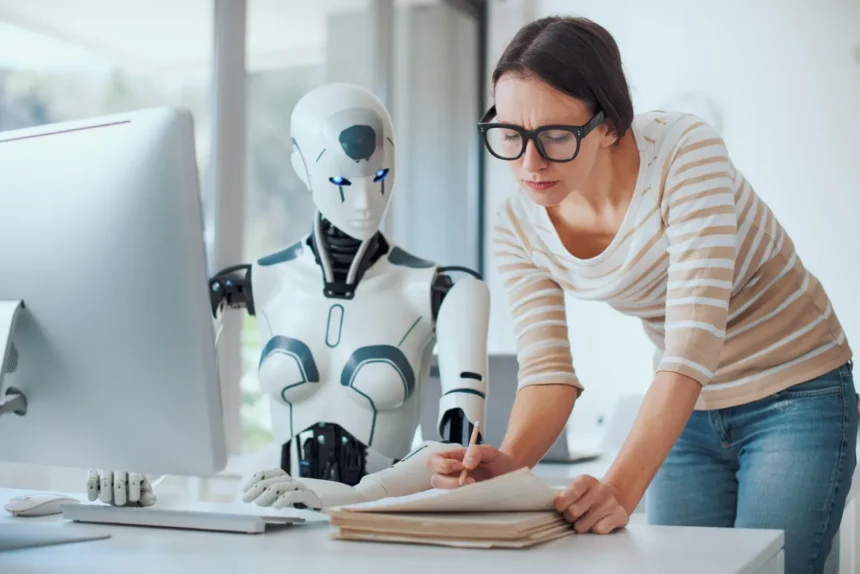
In healthcare, clinicians are using AI tools to read scans faster and more accurately. Far from replacing doctors, the technology allows them to focus on patient care and complex decision making.
In customer service, AI agents handle routine enquiries, freeing staff to assist with more complicated or emotionally sensitive cases. Even in pharmaceuticals, generative AI tools can draft clinical reports with greater speed and precision but only because human writers guide and verify every step.
“AI is not here to take over our jobs. It is here to support us. Machines can handle data and repetitive tasks but humans bring judgment, creativity and ethical oversight that machines cannot replicate.” – Dr Shafika Isaacs, UNESCO

Management and Leadership in the AI Era
As AI takes on more analytics and reporting, leaders are spending less time supervising and more on coaching, influencing, and integrating human AI teams. Understanding AI involves what it can and cannot do, has become a core skill, not to code, but to guide, balance efficiency with safety, and ensure accountability. The most successful workers in the age of AI would be the AI translators; these are people who can speak the language of AI and guide intelligent machines. The speed of technological change will make adaptability the ultimate human superpower.
Who Is Most at Risk and Why ?
AI’s impact is not uniform. Some roles including administrative, clerical, and routine service work—face higher immediate risks of automation. Others, including creative, managerial, or technical roles, are being transformed rather than eliminated.

Physical, manual, and industrial jobs are also evolving, as AI-powered machines handle repetitive or high-risk tasks.
“While one in four jobs is likely to be transformed by AI, this doesn’t necessarily mean net job losses.” – International Labour Organization (ILO)

New Opportunities Are Emerging
Despite these changes, AI is creating new roles we could not have imagined twenty years ago. Sectors such as healthcare, technology, AI ethics, and sustainability are projected to grow, creating demand for skilled workers.
Unique human abilities such as creativity, critical thinking, emotional intelligence, and problem solving, remain in high demand.
“The global education system will need 44 million teachers by 2030. We believe that it is a mistake to argue that we need to invest more in AI technologies rather than investing in teachers. AI can manage data transfer, but it cannot manage human development. Education is fundamentally a social, human and cultural experience and not a technical download.” – Shafika Isaacs, UNESCO
Developing AI responsibly means ensuring human rights, dignity, and inclusiveness remain at the core to avoid societal harm. Unchecked automation could replace frontline roles in social services and customer support, leaving communities without human care. Psychologists caution that excessive reliance on AI risks dulling empathy and interpersonal skills, making ethical safeguards essential to keep technology working for people, not against them.

“Tools that threaten dignity, equality or freedom should be restricted or banned, and governments must actively regulate and enforce these standards.” – UNESCO Recommendation on the Ethics of Artificial Intelligence, 2021
Humans Remain Irreplaceable
The lesson is clear: AI is reshaping how we work, but humans are far from irrelevant. Success depends on adaptability, lifelong learning, and embracing AI as a tool rather than a threat. Workers who develop AI literacy, prioritise human-centered tasks, and fully apply their judgment and creativity will not only survive in the changing workplace but will also excel. By learning to collaborate effectively with AI, understanding its limitations, and focusing on uniquely human skills such as problem-solving, critical thinking, and empathy, employees can create value that machines cannot replicate and position themselves as indispensable contributors in the AI-driven economy
“This is not an issue that an individual government, private sector, or civil society can navigate alone.” – UN
The rise of AI presents a unique opportunity to rethink the future of the job market and confront long-standing inequalities in the workforce. To seize this moment, deliberate action is required: governments, employers, and educators must equip workers with the training, resources, and support needed to adapt to rapidly changing roles. By fostering AI literacy, promoting lifelong learning, and prioritising human-centric skills, workers can not only keep pace with technological change but also take on leadership roles, innovate within their industries, and thrive in an economy increasingly shaped by intelligent machines. The challenge is significant, but the potential rewards are greater inclusivity, smarter workplaces, and a more resilient workforce are even greater.

In short, AI is not just about disruption. It is a chance to rethink the future of work, enhance productivity, and empower people to lead in an evolving economy. Human creativity, judgment, and ethical insight remain the ultimate competitive advantage.